Asset Allocation for Your Child: A Practical Guide to Investing for Their Future
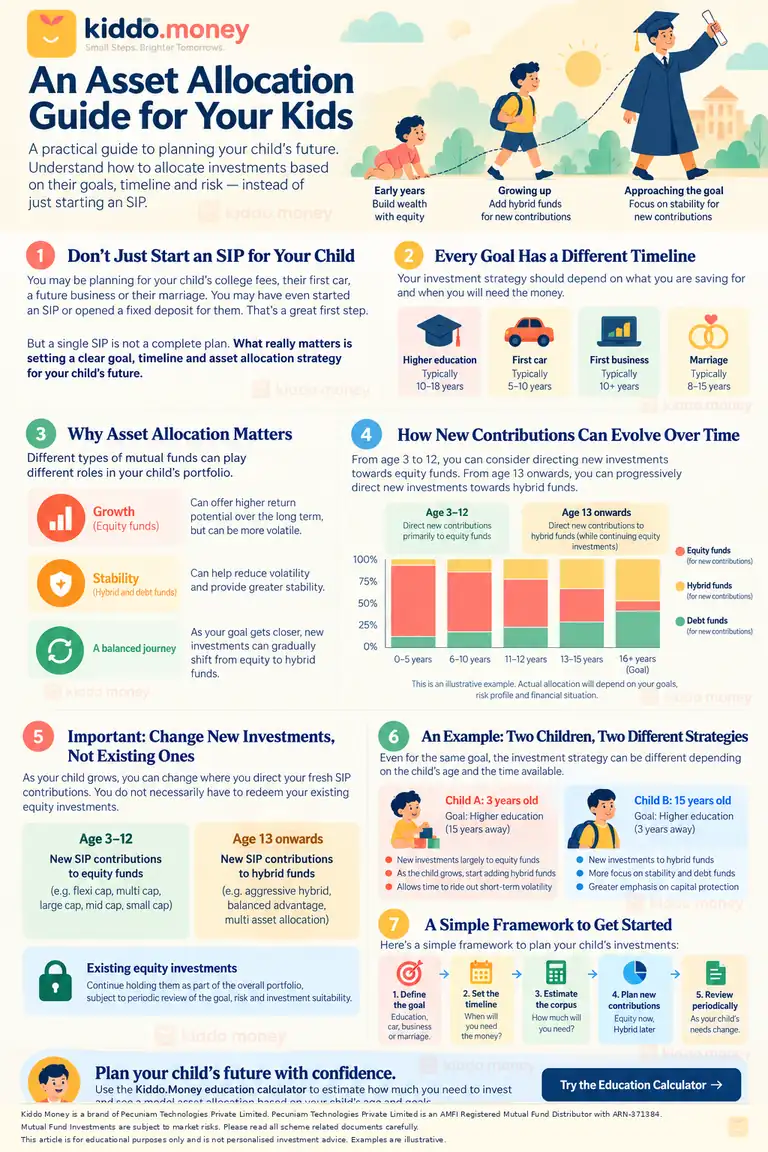
Starting an SIP for your child is a good habit. But the bigger question is how to allocate your investments, and how that strategy should evolve as your child grows older.
1. Why You Need an Investment Plan, Not Just an SIP
Many parents begin investing for their children by selecting a mutual fund and starting a monthly SIP. While this is a great habit, choosing a fund is only one part of the investment process.
What you really need is a plan that answers three questions:
- What are you investing for?
- When will you need the money?
- How should you allocate your investments to work towards that goal?
Your child's higher education, first car and future business venture are very different financial goals. They may have different timelines, financial requirements and levels of flexibility.
If your child is three years old, you may have more than a decade before you need the money for higher education. If your child is already fifteen, the investment horizon is considerably shorter. Both parents may have the same goal, but they cannot necessarily follow the same investment strategy.
Start by defining the goal and its timeline. Only then should you decide where to invest.
2. What Is Asset Allocation and Why Does It Matter?
Asset allocation means deciding how to distribute your investments across different asset classes and investment categories. For a long-term financial goal, this could involve a combination of equity, debt and hybrid mutual funds.
Equity mutual funds invest primarily in shares of companies. They offer the potential for long-term capital appreciation, but their values can fluctuate significantly. They are generally more suitable for investors who can tolerate volatility and have a sufficiently long investment horizon.
Debt mutual funds invest in fixed-income securities. Depending on the scheme, they can help provide relatively greater stability to a portfolio. However, they also carry risks, including interest-rate and credit risk.
Hybrid mutual funds invest in a combination of equity and debt. They offer exposure to multiple asset classes within a single scheme. Depending on their allocation and strategy, they can help balance growth and stability. Hybrid funds are not risk-free, and their risk varies across categories.
The objective is not to find one perfect mutual fund. It is to build a portfolio where different investments work together towards a specific financial goal.
3. Investing When Your Child Is Young: Focus on Equity
When your child's financial goal is many years away, you have more time to ride out market volatility. If you are investing for higher education that is more than ten years away, you could consider directing a larger proportion of your fresh investments towards equity mutual funds.
Depending on your risk tolerance and investment objectives, categories such as large-cap, flexi-cap, multi-cap, mid-cap and small-cap funds may be worth evaluating. Each category has a different investment strategy and risk profile. Mid-cap and small-cap funds, for example, can experience greater volatility.
Focused, thematic and momentum-oriented funds are more specialised strategies. They may introduce additional concentration or strategy-specific risks and should not automatically become building blocks of every child's portfolio.
The important idea is that when your child is young and the financial goal is far away, you can consider allocating fresh investments more towards equity, provided your family's financial circumstances and risk tolerance support it.
The focus during these early years is wealth creation through fresh equity contributions.
4. What Changes When Your Child Turns 13?
As your child grows older, the time remaining before the education goal becomes shorter. This is a good time to review the allocation of your new investments.
Instead of directing all new SIP contributions towards equity funds, you can begin directing fresh contributions towards suitable hybrid mutual funds. Depending on your requirements and risk profile, you could evaluate aggressive hybrid funds, balanced advantage funds or multi-asset allocation funds.
These categories have different approaches to managing equity and debt exposure. The choice should depend on the actual scheme allocation, investment strategy and risk involved.
An important distinction: changing new investments is not the same as redeeming existing investments.
You do not necessarily have to sell your existing equity mutual fund units or transfer the accumulated corpus into hybrid funds. The strategy discussed here is about directing new investments differently as your child grows older.
- From age 3 to 12: Direct fresh SIP contributions primarily towards selected equity funds, where suitable.
- From age 13 onwards: Start directing fresh SIP contributions progressively towards suitable hybrid funds.
- Existing equity investments: Continue holding them as part of the overall portfolio, subject to periodic review of the goal, risk and investment suitability.
This way, your portfolio can gradually build exposure to hybrid investments through fresh contributions, without automatically redeeming the equity investments accumulated over the earlier years.
The age of thirteen is an illustrative point to review fresh contributions, not a universal rule. The timing and allocation should depend on the financial goal, its timeline and your family's circumstances.
The idea is to change where you invest new money, not necessarily what you already own.
5. Two Children, Two Different Investment Strategies
Consider two parents who are investing for their children's higher education. Both have the same broad objective, but their children are at different stages of life.
Child A: 3 years old
The family has approximately fifteen years before the education goal. They could consider directing a larger proportion of fresh investments towards equity mutual funds during the early years. As the child grows older, they can begin directing new contributions towards suitable hybrid funds. Existing equity investments can remain invested, subject to periodic review.
Child B: 15 years old
The family has only around three years before the expected education expense. Following the same strategy as the first family may not be appropriate. They may need to give greater importance to stability and the availability of money when required. Depending on their circumstances, they could consider suitable hybrid or debt-oriented options for fresh investments.
The difference is not simply the child's age. It is the time available before the money is needed.
6. Build an Investment Plan Around Your Child's Future
A sensible investment plan for your child should begin with the financial goal, not the mutual fund.
- Define the goal. Decide whether you are investing for higher education, a first car, a business venture or another milestone.
- Establish the timeline. Estimate when you will need the money. Different goals may have different timelines.
- Estimate the required corpus. Consider the expected cost of the goal and how inflation could affect it.
- Decide your asset allocation. Determine how much exposure to equity, debt and hybrid investments is appropriate for your goal and risk tolerance.
- Plan your future contributions. Decide how fresh SIP contributions should be allocated as the goal approaches. You can gradually direct new investments towards relatively more stable categories without automatically redeeming existing equity holdings.
- Review your investments periodically. Your child's needs will change over time. Review your portfolio, investment horizon and allocation to ensure the strategy remains appropriate.
The Bottom Line
Starting an SIP for your child is a wonderful habit. But investing regularly is only one part of the equation.
What matters is having a clear financial goal, an appropriate investment horizon and an asset allocation strategy that evolves as your child grows older.
You may begin by directing fresh investments towards equity mutual funds when your child is young. As the child approaches their teenage years, you can progressively direct new contributions towards suitable hybrid funds.
Your existing equity investments need not be automatically redeemed or switched as part of this approach.
At Kiddo.Money, we believe that the goal should come before the mutual fund.
Plan the goal. Estimate the corpus. Decide the allocation. Then choose the investments.
Your child's future deserves more than a collection of SIPs. It deserves a plan.
Start with your child's education goal
Estimate how much you may need for your child's education using the Kiddo.Money Education Calculator.
Try the Education Calculator →About Kiddo.Money
Kiddo.Money is a brand of Pecuniam Technologies Private Limited. Contact: hello@pecuniam.in.